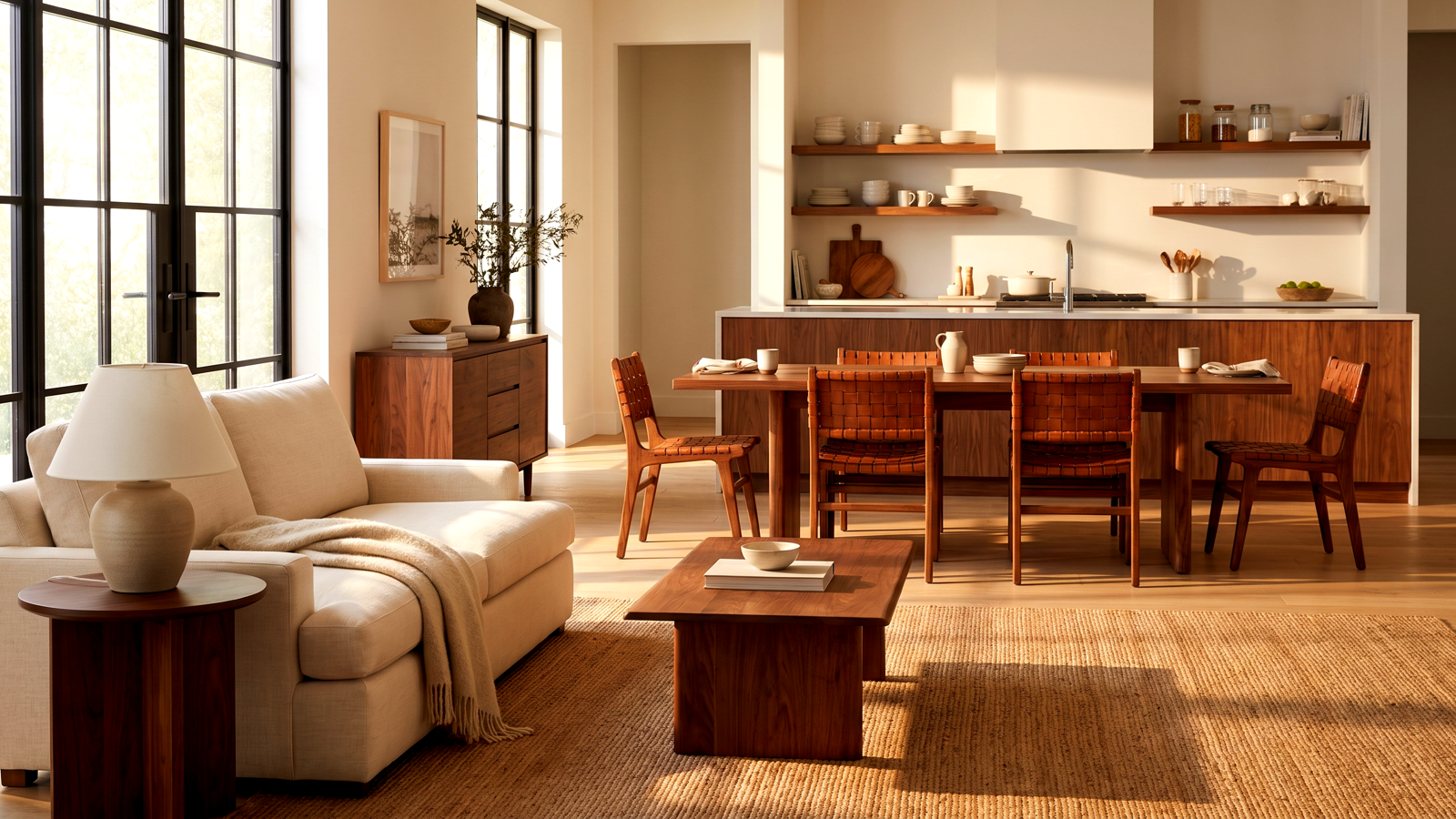
When your kitchen, dining room, and living area all flow into one another without walls to break things up, every design decision carries extra weight. There’s nowhere to hide a mismatched finish or an awkward colour clash. That’s what makes choosing the right wood tone for an open-concept home one of the most important — and most rewarding — decisions you’ll make when furnishing or renovating your space.
At Black Barrel Wood Co., we work with homeowners across Innisfil and the greater Barrie area who are navigating exactly this challenge. Whether they’re building a new custom piece or trying to tie together furniture they already own, the conversation almost always starts with wood tone. Here’s what we’ve learned.
Why Wood Tone Matters More in Open-Concept Spaces
In a traditional home with defined rooms, each space has its own design bubble. Your kitchen cabinets don’t have to “talk to” your living room bookshelf because a wall separates them. But in an open-concept layout, every piece of furniture is in conversation with every other piece — constantly, from every angle.
This means a warm honey oak dining table placed next to a cool grey-washed TV console can create visual tension that makes the whole space feel unsettled, even if you can’t immediately put your finger on why. Conversely, when wood tones are coordinated thoughtfully, the room feels unified, calm, and intentional.
It’s worth noting that “matching” doesn’t mean “identical.” In fact, perfectly matching every wood piece to the same stain can look flat and manufactured. The goal is harmony — a family of tones that complement each other and anchor the room together.
Understanding the Warm-to-Cool Spectrum
All wood tones sit somewhere on a spectrum from warm to cool, and understanding this is the foundation of good wood tone selection.
Warm Wood Tones
Warm tones include honey oak, golden walnut, amber pine, and reddish mahogany. These woods tend to pick up yellow, orange, and red undertones. They create a cozy, inviting atmosphere and work beautifully in spaces with natural light, earthy textiles, and warmer paint colours (think creamy whites, taupes, and sage greens).
In an open-concept home, warm wood tones tend to make large spaces feel more grounded and intimate — which can be a real asset when you’re trying to prevent a sprawling floor plan from feeling cold or impersonal.
Cool and Mid-Tone Woods
On the cooler end of the spectrum, you’ll find grey-washed ash, ebonized oak, and lighter bleached or whitewashed finishes. Mid-tones like natural walnut and medium-brown stained maple sit in between — versatile enough to work with both warm and cool palettes.
Cool-toned wood selections work especially well in modern and Scandinavian-inspired interiors, pairing naturally with white walls, concrete accents, and muted blues or charcoals. If your open-concept space leans contemporary, a cooler wood palette can feel sleek and sophisticated without being sterile.
How to Create Visual Flow Across an Open Floor Plan
Once you understand the warm-to-cool spectrum, the next step is applying it strategically across your open-concept furniture selections.
Anchor with Your Largest Pieces First
Start with the biggest, most permanent pieces — flooring, kitchen cabinetry, or a large dining table. These set the tone for everything else. If your hardwood floors are a medium warm brown, you now have a reference point. Pieces that are slightly lighter or slightly darker within that same warm family will harmonize naturally. Pieces that jump to a completely different temperature (say, a very grey-washed console table) will create contrast that feels jarring rather than intentional.
If you’re commissioning custom furniture from a studio like ours, this is actually an advantage. We can match or complement your existing finishes precisely, rather than hunting through showrooms hoping something is close enough.
Use the 60-30-10 Rule for Wood Tones
Just like interior designers apply the 60-30-10 rule to colour (60% dominant, 30% secondary, 10% accent), you can apply the same logic to wood tones in an open-concept space.
- 60% of your wood elements share the dominant tone — your floors, main cabinetry, or large furniture pieces.
- 30% introduce a complementary wood tone — perhaps lighter floating shelves or a dining bench in a slightly different finish.
- 10% are accents — small side tables, decorative objects, or a statement chair in a contrasting tone that ties the room together.
This approach prevents the monotony of a single-tone room while keeping everything feeling cohesive and considered.
Don’t Forget the Undertones in Your Paint and Textiles
Matching wood finishes isn’t just about the wood — it’s about the whole room. Your wall colour, upholstery, and even your rug all carry undertones that will either amplify or clash with your wood tones.
A warm greige wall with yellow or pink undertones will make warm wood tones sing. The same wall can make a cool grey-washed piece look disconnected. If you’re unsure whether your existing finishes lean warm or cool, hold a piece of white paper next to the surface in natural daylight — the undertones will reveal themselves more clearly.
If you’re in the planning stages of a renovation or custom furniture project, we’re always happy to talk through the whole picture. Reach out to us at Black Barrel Wood Co. and we can help you think through how a custom piece will interact with the rest of your space.
Common Mistakes to Avoid
Matching Too Perfectly
As mentioned earlier, identical stain on every piece can look like a furniture set from a big-box store — coordinated, but lacking depth and personality. Allow for variation within a family. A slightly lighter wood on floating shelves adds dimension against a darker walnut dining table.
Ignoring Natural Light Direction
North-facing rooms tend to feel cooler, so warm wood tones can counterbalance this and prevent the space from feeling dreary. South-facing rooms already have a warmth to them and can handle cooler or more neutral wood tones without losing their energy. If your open-concept space spans both orientations (which many do), choose a wood tone that lands in the middle of the spectrum — a medium walnut or natural white oak tends to be extremely versatile.
Overlooking Grain Pattern
Wood tone is about more than stain colour — the grain pattern matters, too. A wild, heavily figured grain pattern can visually compete with a subtle, straight-grained piece even if they share a similar colour. For open-concept spaces where everything is visible at once, choosing woods with compatible grain styles (both subtle, or both bold — rarely one of each) helps maintain visual calm.
When to Consider Custom Over Ready-Made
For many homeowners, the challenge isn’t knowing what they want — it’s finding it. Ready-made furniture comes in a limited range of finishes, and those finishes aren’t always designed to work with Canadian hardwood floors or existing cabinetry from a local millwork shop.
Custom woodworking solves this. When you commission a piece from a local studio, the finish is dialled in to your space specifically. We sample stains, match undertones, and adjust sheen levels to ensure a new dining table or media console integrates naturally — not like it was ordered online and just happened to be close.
If you’re working through an open-concept redesign and feeling stuck on how to bring your wood tones together, we’d love to help you find the right direction. A short consultation can save you months of second-guessing.
Pulling It All Together
Choosing the right wood tone for an open-concept home is ultimately about understanding your space holistically. It requires looking at light, scale, undertones, and the relationship between every piece of furniture in the room — all at once.
Here’s a quick summary of the principles we’ve covered:
- Decide whether your space leans warm or cool, and commit to one direction.
- Anchor your palette with your largest, most permanent pieces.
- Use the 60-30-10 rule to build in variety without losing cohesion.
- Consider undertones in your walls, flooring, and textiles — not just the wood itself.
- Allow for variation within a tone family to avoid a flat, showroom look.
- Factor in grain pattern alongside stain colour.
- Consider custom pieces when ready-made options don’t quite land.
Open-concept living is beautiful precisely because it demands that every element earn its place. When the wood tones work together, the result is a home that feels effortless — like it was always meant to look exactly this way.
If you’re planning a new piece and want a woodworker who takes the whole room into consideration, get in touch with Black Barrel Wood Co.. We’re based in Innisfil, Ontario, and we love helping local homeowners make their spaces feel complete.
Keywords: choosing wood tone open concept home, wood tone selection, open concept furniture, matching wood finishes
Ready to start your own project?
Every piece is built to order in our Innisfil, Ontario studio. Reach out to discuss your vision.
Start a Project