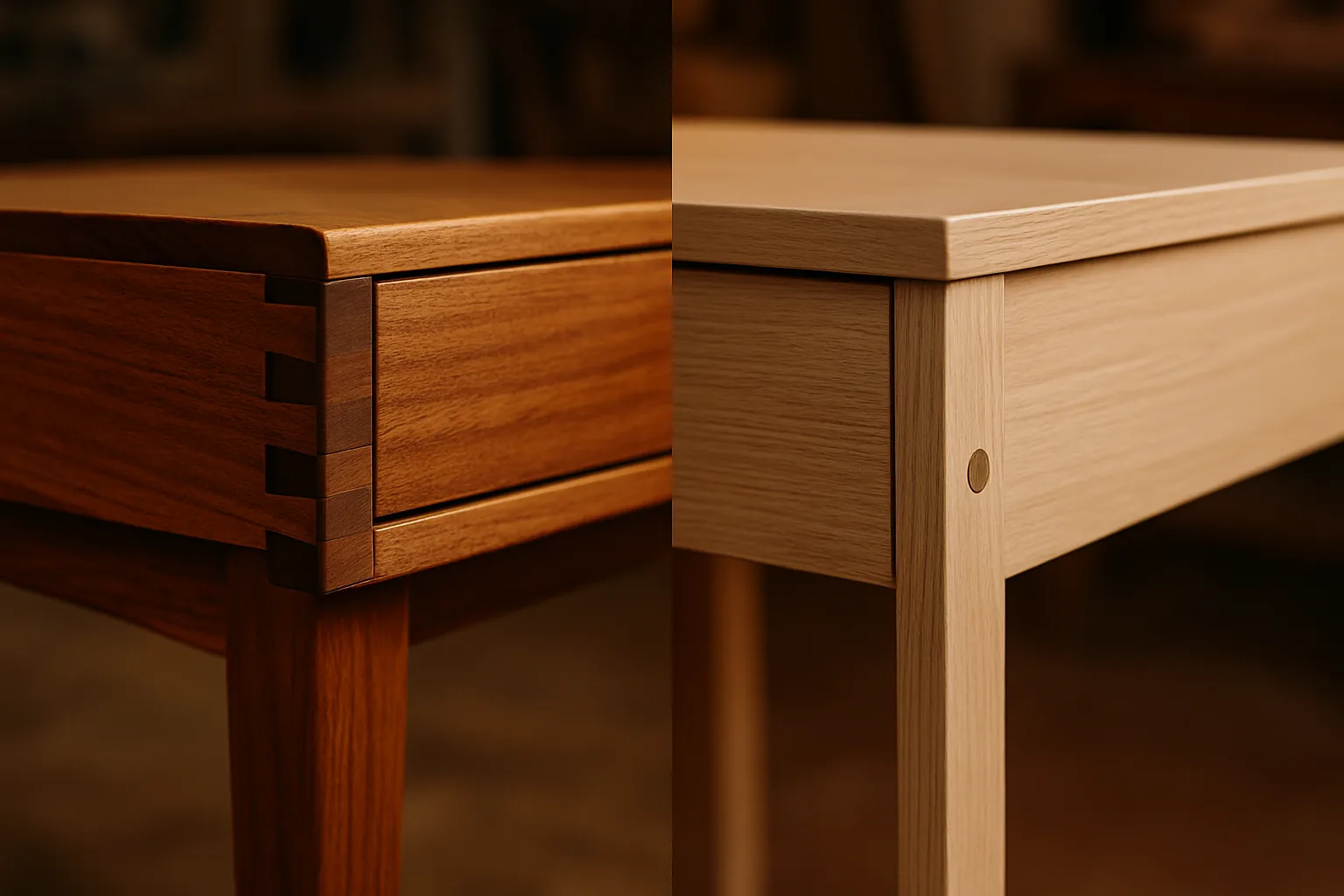
You’re shopping for a new dining table. You’ve found one online at a big box store for $399. You’ve also gotten a quote from a local woodworker for something custom — and it’s closer to $1,800. The sticker shock is real. But before you click “Add to Cart,” it’s worth slowing down and asking a harder question: are you actually comparing the same thing?
This post breaks down the honest difference between custom furniture vs big box stores — not to talk you into spending more, but to help you understand what you’re actually paying for at each price point. Because sometimes the big box store is the right call. And sometimes it’s the most expensive mistake you’ll make.
What You’re Actually Buying at a Big Box Store
Let’s start with what makes flat-pack and mass-produced furniture so appealing: it’s affordable, it’s available right now, and you can see exactly what it looks like before you buy it. For a starter apartment, a kid’s room, or a temporary space, that math can make a lot of sense.
But the furniture price comparison gets more complicated when you look past the price tag.
The Materials Behind the Price
Most mass-produced furniture — even pieces from mid-range retailers — is built from engineered wood products like MDF (medium-density fibreboard), particleboard, or HDF. These materials are manufactured from compressed wood fibres and adhesives, which makes them cheap to produce and consistent to machine. But they have real limitations:
- They don’t handle moisture well. Swelling, warping, and delamination are common in kitchens, bathrooms, and anywhere with humidity swings.
- They don’t hold fasteners well over time. Cam locks and screws in particleboard loosen with every reassembly or move.
- They can’t be refinished. Once the laminate chips or the veneer peels, you’re looking at replacement, not repair.
That’s not a knock on the stores selling this furniture — it’s just the reality of what the manufacturing process allows at that price point.
The Assembly and Longevity Factor
There’s also the question of joinery. Mass-produced furniture is designed to be assembled by a consumer with an Allen key in 45 minutes. That convenience comes with trade-offs: cam locks instead of mortise-and-tenon joints, stapled drawer boxes instead of dovetails, and glued-on backs instead of dadoed panels.
None of this is inherently wrong for the right use case. But it does affect how long the piece will realistically last — and what happens to it when it starts to fail.
What Custom Furniture Actually Costs (and Why)
When someone gets a quote for a custom piece and feels the sticker shock, it’s usually because they’re comparing a number without understanding what’s inside it. The custom furniture value conversation needs to start with what you’re actually buying.
Solid Wood and Real Materials
Custom furniture built by a skilled woodworker typically uses solid hardwood — species like maple, walnut, white oak, cherry, or ash. These are real trees, kiln-dried and milled, with grain patterns that are unique to each board. Solid wood:
- Expands and contracts naturally with seasonal humidity changes (and is built to accommodate this)
- Can be sanded and refinished multiple times over decades
- Gets stronger at its joints over time, not weaker
- Develops a patina and character that engineered wood simply can’t replicate
The material cost alone for solid hardwood is dramatically higher than engineered panels — and that’s before a single cut is made.
The Labour of Craftsmanship
In the handmade vs mass-produced conversation, labour is the biggest variable. A factory in Southeast Asia can produce dozens of cabinets per hour using CNC machines and automated assembly lines. A custom woodworker in Innisfil is spending hours — sometimes days — on a single piece. Hand-fitting joints, flattening slabs, selecting and matching grain, applying finish by hand in multiple coats.
That time isn’t waste. It’s the thing that makes the piece last 30 years instead of 5.
It’s Built for Your Space
Here’s something big box stores simply can’t offer: a piece that fits your actual room, your actual life, and your actual taste. Custom furniture is designed around your ceiling height, your flooring, your existing pieces, your storage needs. There’s no “close enough” — it either fits or it doesn’t get built.
If you’ve ever tried to squeeze a standard-sized buffet into an awkward dining room, or watched a bookcase wobble because the ceiling was slightly lower than expected, you understand the value of something made specifically for your space.
A Real Furniture Price Comparison: The 10-Year View
Here’s a reframe that changes the math for a lot of people: don’t compare the purchase price. Compare the cost per year.
A $400 dining table that needs to be replaced in 4–5 years costs you $80–100 per year. A $1,800 custom table that lasts 25–30 years costs you $60–72 per year — and that’s before accounting for the fact that it likely holds or increases its value, and can be repaired rather than replaced.
This isn’t true for every situation. If you’re furnishing a college rental or a short-term space, buying cheap makes complete sense. But for a forever home, a primary dining room, or a piece you genuinely care about — the economics of custom furniture often hold up better than they first appear.
The Hidden Costs of Going Cheap
It’s also worth naming the costs that don’t show up on the receipt:
- Replacement frequency. Most flat-pack furniture lasts 3–7 years with regular use.
- Moving damage. Particleboard doesn’t survive moves well. Solid wood does.
- Emotional cost. There’s a real frustration in owning furniture you don’t love, that’s falling apart, that you feel neutral about.
- Environmental impact. Furniture that ends up in a landfill every few years has a compounding environmental cost that a single well-built piece doesn’t.
So When Does Custom Furniture Make Sense?
Not every piece needs to be custom. Here’s an honest take on when it makes sense — and when it doesn’t.
Good candidates for custom furniture:
- Dining tables and chairs (used daily, socially visible, expected to last)
- Kitchen islands and built-ins (need to fit exact dimensions)
- Bedroom furniture for your primary bedroom
- Home office desks and shelving systems
- Heirloom pieces you want to pass down
- Any space where off-the-shelf sizing just doesn’t work
Situations where big box makes sense:
- Temporary or transitional spaces
- Children’s furniture they’ll outgrow
- Guest rooms with low usage
- Budget constraints that are genuinely firm
There’s no shame in either answer. The goal is just to go in with clear eyes about what you’re buying.
Working With a Local Custom Woodworker
If you’re leaning toward custom, working with a local studio has advantages that go beyond the piece itself. You can talk through the design. You can see material samples in person. You can ask questions throughout the build. And you’re supporting a local craftsperson rather than a supply chain that stretches across the globe.
At Black Barrel Wood Co., we work with clients in Innisfil and across Simcoe County to build furniture that actually fits their homes and their lives. We’re happy to walk you through what’s possible at different price points — no pressure, just honest conversation.
Get in touch to talk through your project →
Questions to Ask Before You Buy
Whether you’re leaning toward custom or off-the-shelf, here are a few questions worth asking:
- What is this actually made of? Solid wood, plywood, MDF, or particleboard?
- How is it joined? Screws and cam locks, or traditional joinery?
- Can it be repaired or refinished?
- Does it fit my space — really?
- How long do I expect to own this?
- What does the cost-per-year actually look like?
Answering these honestly usually makes the decision a lot clearer.
The Bottom Line
The custom furniture vs big box stores debate isn’t really about one being “better” in some absolute sense. It’s about understanding what you’re buying and matching that to what you actually need.
If you want something that fits your space exactly, is built from real materials, will last for decades, and is made by someone who takes genuine pride in their work — custom furniture is worth the price. If you need something functional for a space you’re not committed to yet, the big box store serves a real purpose.
For the pieces that matter most, though, the investment in something handmade tends to pay off — in longevity, in satisfaction, and in the simple pleasure of owning something made well.
If you’re ready to explore what a custom piece might look like for your home, we’d love to hear from you. And if you’re still in the research phase, that’s completely fine too — we’re happy to answer questions without any obligation.
Reach out to Black Barrel Wood Co. to start the conversation →
Ready to start your own project?
Every piece is built to order in our Innisfil, Ontario studio. Reach out to discuss your vision.
Start a Project