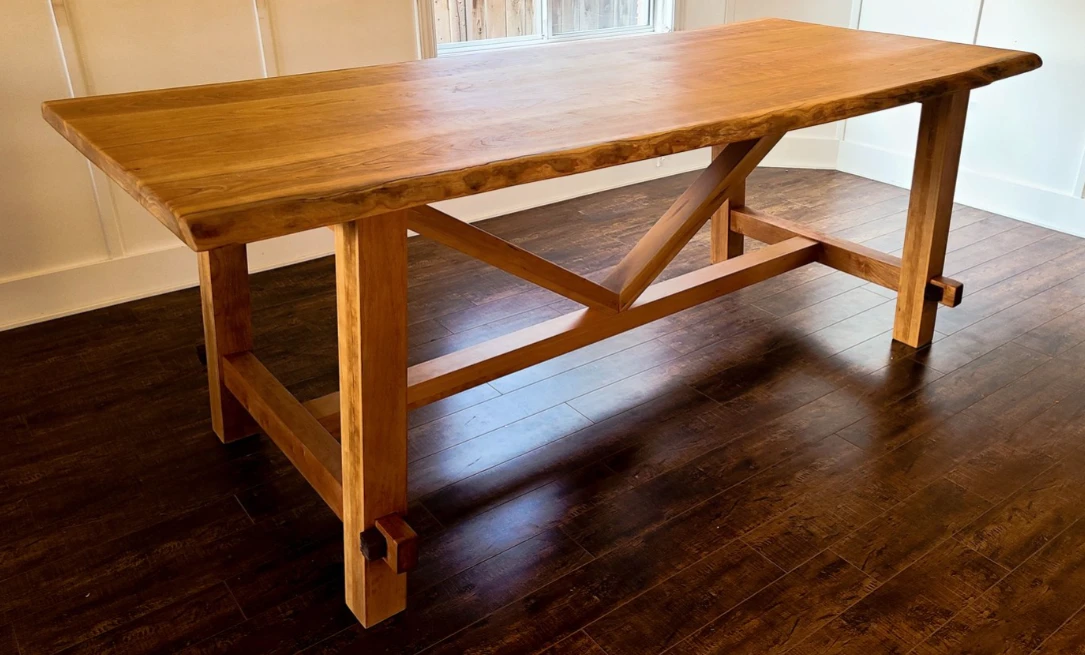
There’s a moment almost every homeowner has experienced: you fall in love with a dining table online, it arrives at your door, and then — somehow — it swallows your dining room whole. Or worse, it looks like a postage stamp floating in an ocean of empty floor space.
Getting the size right before you buy (or build) is the single most important decision you’ll make about your dining table. Everything else — the wood species, the finish, the leg style — comes after. So if you’re wondering how to choose dining table size for your specific room, you’re in the right place. This guide walks you through the real measurements that matter, in plain language.
Start With Your Room, Not the Table
It sounds obvious, but most people start by browsing tables and then try to make the dimensions work afterward. Flip that process. Your room sets the rules.
Measure Your Dining Room First
Grab a tape measure and note the full length and width of your dining room. Write those numbers down. Then identify any fixed elements that will affect traffic flow:
- Doorways and entry points — you need clear passage in and out
- Windows and sills — chairs pushed back can’t block opening a window
- Built-ins, buffets, or china cabinets — these reduce usable floor space
- Kitchen island overhangs — in open-concept layouts, the island often acts as one wall of the dining zone
Once you have those dimensions in hand, you’re ready to work with the golden rule of dining table sizing.
The 36-Inch Clearance Rule
The most widely used standard in furniture planning is this: leave at least 36 inches (about 90 cm) of clearance on all sides of your dining table. This gives seated guests enough room to push their chairs back comfortably, and it allows someone to walk behind them without squeezing through.
If space is tighter, you can go down to 30 inches on walls where no one will be walking — the side of the table pushed closest to a wall, for example. But maintain the full 36 inches on any side that serves as a walkway.
Here’s a quick formula to find your maximum table size:
Maximum table length = Room length minus 72 inches (36“ clearance on each end)
Maximum table width = Room width minus 72 inches (36“ clearance on each side)
So if your dining room is 12 feet (144 inches) long and 10 feet (120 inches) wide, your table can be up to 72 inches long and 48 inches wide. That’s a 6-foot by 4-foot table — a very comfortable size for most families.
Standard Dining Table Dimensions to Know
Now that you understand how room size affects your options, let’s talk about the dining table dimensions you’ll actually encounter — and what they’re suited for.
Rectangular Tables: The Most Common Shape
Rectangular tables are the most popular choice for a reason: they make efficient use of space, seat a predictable number of people, and work well in rooms of almost any proportion.
| Table Length | Comfortable Seating |
|---|---|
| 48 inches (4 ft) | 4 people |
| 60 inches (5 ft) | 4–6 people |
| 72 inches (6 ft) | 6 people |
| 84 inches (7 ft) | 6–8 people |
| 96 inches (8 ft) | 8–10 people |
A standard table width runs between 36 and 42 inches. Narrower tables (around 30–32 inches) work in tighter rooms but limit how much you can put in the centre — dishes, candles, floral arrangements — without things feeling cramped.
Round and Square Tables: Best for Smaller Spaces
Round tables are a great choice for square rooms or smaller dining areas. They encourage conversation (no one is stuck at the “end”), and the absence of corners means slightly more walkable space around them.
- A 42-inch round seats 4 comfortably
- A 54-inch round seats 4–6
- A 60-inch round seats 6
Square tables follow similar logic. A 48 x 48-inch square is ideal for four people and suits a compact dining nook beautifully.
How Many People Do You Actually Need to Seat?
This is where homeowners often overthink it. Think about your everyday use, not your maximum holiday seating. If it’s typically you, your partner, and two kids at dinner, a 60-inch rectangular table is probably your sweet spot — even if you host Thanksgiving for twelve once a year.
Plan for Everyday, Prepare for Guests
For everyday seating, the standard rule is 24 inches of table length per person on the long sides, and 18 to 24 inches per person on the ends. This gives each guest enough elbow room without feeling crowded.
For special occasions, consider a table with a leaf extension. An extension leaf — which can be custom-built into almost any table design — lets a 72-inch table grow to 96 inches when you need it. It’s one of the smartest investments in a dining table, and something we build into many of our custom pieces here in Innisfil.
If you’re not sure what configuration would work best for your space and lifestyle, reach out to us at Black Barrel Wood Co. — we’re happy to talk through options with no obligation.
Open-Concept Living: A Few Extra Considerations
More and more homes in Barrie, Innisfil, and the surrounding area are built with open-concept main floors. The dining “room” isn’t really a room at all — it’s a zone defined by a rug, a light fixture, and proximity to the kitchen. This changes the sizing conversation a little.
Define the Zone Before You Size the Table
In an open layout, your dining area is usually anchored by a chandelier or pendant light above. That fixture’s centre point should be directly over the centre of your table. If the light is already installed, it tells you exactly where your table needs to live — and how much space you have to work with on each side before you hit the kitchen island or the living room sectional.
A good rule of thumb: the pendant or chandelier should be roughly the same width as your table (or within 12 inches narrower). A tiny fixture over a massive table looks just as off as an oversized drum shade over a small bistro table.
Visual Weight Matters in Open Spaces
In a closed dining room, a large table fills the space and feels intentional. In an open-concept layout, a table that’s too large can dominate the entire floor plan and make the adjacent living area feel cramped. Here, erring slightly smaller — and using benches instead of chairs on one side — can keep the space feeling open and airy.
Don’t Forget Table Height
All of the above assumes a standard dining table height of 28 to 30 inches, which pairs with dining chairs that have a seat height of 17 to 19 inches. This proportion gives you a comfortable 9 to 13 inches of clearance between the seat and the underside of the table — enough for thighs to fit without crowding.
If you’re drawn to a counter-height or bar-height table (sometimes called pub tables), know that these require different chairs or stools, and they change the feel of the room significantly — more casual, less formal.
Putting It All Together: A Quick Checklist
Before you commit to any dining table, run through this list:
- Measured room dimensions (length and width)
- Identified obstacles: doors, windows, built-ins
- Applied the 36-inch clearance rule on all sides
- Determined typical seating needs (everyday, not just holidays)
- Considered a leaf extension for flexibility
- Confirmed table height matches your chair selection
- Checked that table shape suits the room’s proportions
When Off-the-Shelf Doesn’t Fit
Here’s the reality: dining rooms aren’t always a tidy 10 x 12 feet. Older homes have awkward proportions. Open-concept layouts have irregular shapes. Sometimes the table you need simply doesn’t exist in a standard catalogue size.
That’s exactly why custom woodworking exists. A table built to your exact dimensions — 67 inches long instead of 60 or 72, or 38 inches wide instead of 36 — can make the difference between a room that works and a room that’s always slightly off.
At Black Barrel Wood Co., we build custom dining tables in Innisfil, Ontario, sized precisely to your room and your life. Whether you need a compact table for a cozy bungalow or an eight-foot farmhouse slab for a forever home, we’d love to help you get it right.
Get in touch with us here to start a conversation about your project — we’ll walk through the measurements together and help you figure out exactly what will work in your space.
Getting the size right is the foundation of a dining table you’ll love for decades. Take the time to measure, plan your clearances, and think honestly about how you use your space day to day. The right table isn’t necessarily the biggest one — it’s the one that fits your room, your family, and the way you actually live.
And if you ever want a second set of eyes on your floor plan before you commit, we’re always happy to help.
Ready to start your own project?
Every piece is built to order in our Innisfil, Ontario studio. Reach out to discuss your vision.
Start a Project