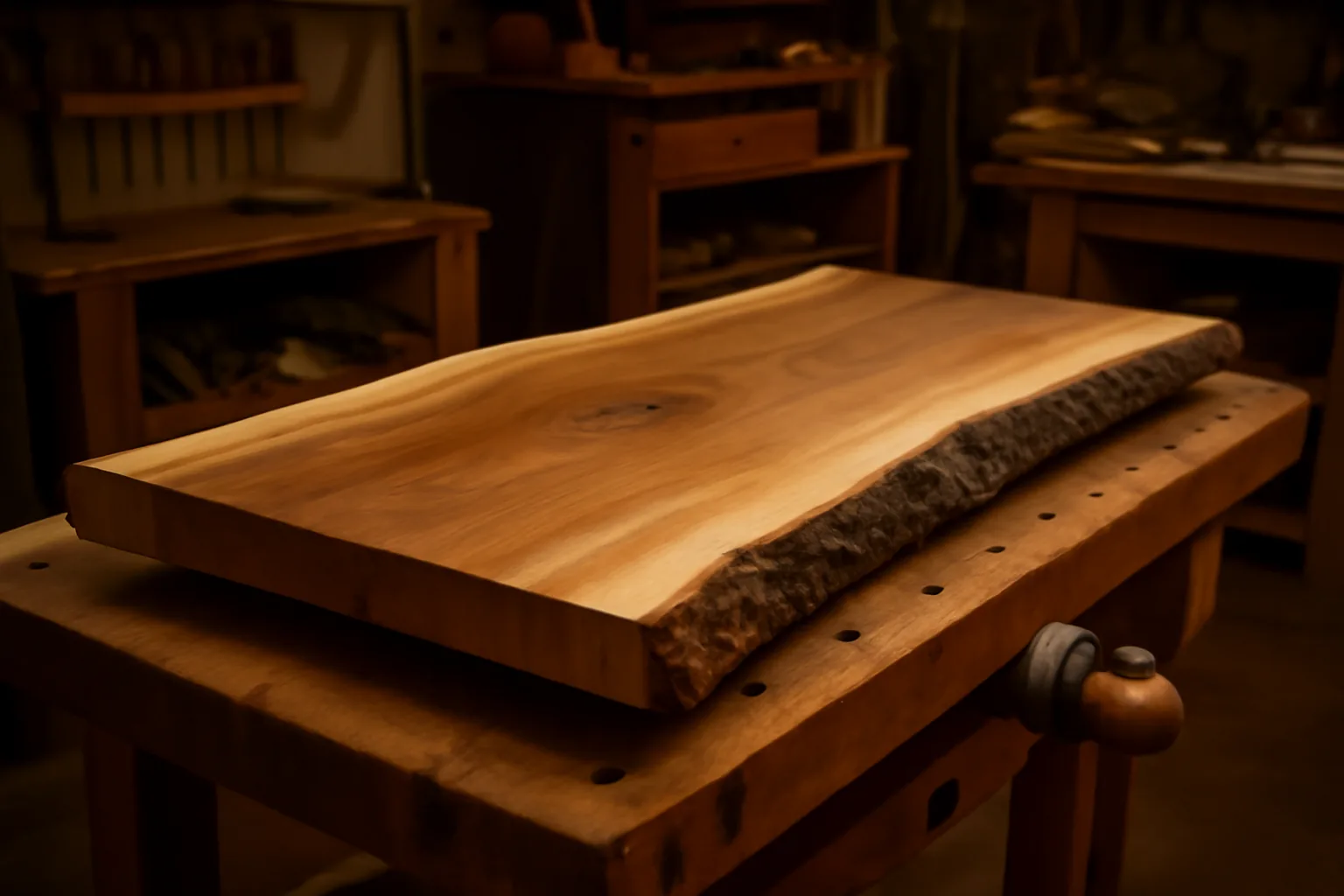
There’s a moment that happens in almost every workshop conversation we have with homeowners. We lay a slab out on the floor, step back, and watch their eyes move along the edge — that wild, uncut curve where the tree used to meet the world. Nine times out of ten, someone says: “Wait. What exactly am I looking at?”
That’s a fair question. Live edge wood has become one of the most talked-about materials in interior design over the last decade, but the term gets thrown around a lot without much explanation. So let’s slow down and actually answer it — what is live edge wood, where does it come from, and more importantly, is it the right choice for your home?
What Is Live Edge Wood, Exactly?
Live edge wood refers to lumber that has been cut from a tree while preserving the natural outer edge of the wood — the part where the bark was. Rather than squaring off every side of a board into a clean, straight line, a live edge slab keeps at least one (and often both) of the original edges of the tree intact.
The result is a piece of wood that carries the actual silhouette of the tree it came from. Every dip, curve, bump, and contour you see along the edge was shaped by decades — sometimes centuries — of growth. No two slabs are ever identical, which is a big part of why people love them.
You’ll also hear the term natural edge wood used interchangeably with live edge. They mean the same thing. Some woodworkers say “live edge” when the bark is still partially attached, and “natural edge” when the bark has been removed but the organic profile is preserved — but honestly, in everyday use, the terms overlap heavily.
How Is a Live Edge Slab Made?
When a large tree is felled — whether due to storm damage, land clearing, disease, or sustainable harvesting — the trunk can be taken to a sawmill and cut into slabs rather than dimensional lumber. Instead of slicing the tree into uniform boards, the sawyer makes long, flat cuts straight through the full width of the trunk. These wide cuts produce slabs that preserve the full natural edge on each side.
The slabs are then dried — either air-dried over one to three years, or kiln-dried in a controlled environment. Proper drying is critical. Wood that hasn’t been dried correctly will warp, crack, or split over time. After drying, the slab gets flattened, sanded, and finished. Sometimes voids, cracks, and knots are filled with epoxy. Sometimes they’re left as-is. That’s usually a conversation between you and your woodworker.
What Makes Live Edge Furniture Different?
Live edge furniture sits in a category of its own — somewhere between functional object and piece of art. Here’s what sets it apart from furniture made with conventional, dimensioned lumber.
Every Piece Is One of a Kind
Because you’re working with the actual shape of a real tree, no two live edge tables, desks, or shelves will ever look the same. The grain pattern, the edge profile, the figure in the wood — it all comes from that specific tree, that specific part of the trunk. When you commission a live edge dining table, you’re getting something that genuinely cannot be replicated.
The Wood Has History
A lot of the slabs we work with at Black Barrel Wood Co. come from trees in Ontario — black walnut, maple, cherry, elm, ash. These trees were often growing for 80, 100, or more years before they became lumber. There’s something meaningful about bringing that kind of material into your home, especially if you can trace where it came from.
It Works With More Styles Than You’d Think
Live edge furniture has a reputation for fitting only in rustic or farmhouse interiors, but that’s outdated thinking. A sleek black walnut slab on clean-lined hairpin legs reads as modern and minimal. The same slab on a hand-forged steel base feels industrial. Paired with traditional joinery and warm finishes, it can feel classic and refined. The wood itself is neutral in that way — it takes on the character of everything around it.
Common Uses for Live Edge Slabs
If you’re trying to picture where live edge wood fits in a real home, here are the most common applications we see.
Dining tables are the most popular. A wide slab with a strong grain pattern becomes the centrepiece of a dining room in a way that a standard table rarely does. People gather around it differently — they notice it, touch it, ask about it.
Kitchen islands are a close second. A live edge counter or waterfall island adds warmth to an otherwise hard-surfaced kitchen. It breaks up all the stone and cabinetry in a way that feels organic and intentional.
Desks and home office surfaces have seen a surge in interest. A live edge desk is the kind of thing that makes working from home feel a little more like a privilege than a compromise.
Shelving and floating shelves are a lower-commitment way to bring live edge wood into your space. A single slab shelf in a hallway or bathroom can add a lot of character without a major investment.
Coffee tables, console tables, and side tables round out the list. These are great options if you’re curious about live edge but not ready to commit to a large piece.
Is Live Edge Wood Right for Your Home?
This is where we want to be honest with you, because live edge isn’t the right answer for every situation.
It’s a Long-Term Investment
Live edge furniture — done well — is not inexpensive. You’re paying for premium material, skilled craftsmanship, and something that’s built to last decades. If you’re looking for something budget-friendly or temporary, this probably isn’t the right fit. But if you’re furnishing a space you plan to be in for a long time, it’s worth thinking about cost-per-year rather than sticker price.
Your Space Matters
Live edge slabs tend to be wide, heavy, and visually dominant. In a large, open dining room, that’s a feature. In a small, dark apartment, it can feel overwhelming. Think about the scale of your space, the amount of natural light you have, and how much visual weight the room can comfortably hold.
Wood Is a Living Material
This is something first-time buyers sometimes underestimate. Wood moves. It responds to humidity and temperature changes, expanding and contracting through the seasons. A well-made piece of live edge furniture accounts for this in how it’s constructed and finished. But you should expect that your piece will develop small character marks over the years — a slight check here, a bit of patina there. Some people love that. If you want something that looks exactly the same in 20 years as it does today, wood might not be your material.
When It’s Absolutely the Right Choice
Live edge wood is a wonderful fit when you want furniture that feels personal and meaningful, when you value craftsmanship and natural materials, and when you’re designing a space that you want to feel warm, grounded, and a little unexpected. It rewards curiosity — guests always want to know the story behind it.
If that sounds like you, we’d encourage you to reach out and start a conversation. We’re always happy to talk through ideas before anything is decided.
What to Ask Before You Buy
If you’re seriously considering a live edge piece, here are a few questions worth asking your woodworker:
- Where did the slab come from? Local wood, sustainably sourced, is worth looking for.
- How was it dried, and for how long? This directly affects long-term stability.
- What finish is being used, and how do I care for it? Oil, hardwax, and polyurethane all behave differently.
- How is the base attached? This matters for wood movement. Rigid, inflexible attachments can cause cracking over time.
- Can I see the actual slab before committing? You should always be able to see — and ideally touch — the slab you’re buying.
A woodworker who welcomes those questions is one worth working with. At Black Barrel Wood Co., we encourage clients to come by the workshop, walk the slabs, and get a feel for the material before any decisions are made. Get in touch here to arrange a visit.
The Bottom Line
So — what is live edge wood? It’s lumber that keeps the natural edge of the tree intact, turning a structural material into something that still carries the shape and story of where it came from. Live edge slabs become furniture that’s functional and beautiful, familiar and surprising, built to be used hard and looked at often.
Whether it’s right for your home depends on your space, your budget, your lifestyle, and honestly, whether you’re the kind of person who wants their dining table to have a backstory. If you are, you’ll probably love it.
If you’re still on the fence or have questions we haven’t answered here, we’re easy to reach. No pressure, no pitch — just a conversation about wood.
Ready to start your own project?
Every piece is built to order in our Innisfil, Ontario studio. Reach out to discuss your vision.
Start a Project