You’ve been there. You buy a bookcase or a dining table, it looks great for a couple of years, and then the edges start to chip, the surface bubbles, or the whole thing starts to sag under normal use. You didn’t abuse it — you just used it. The problem usually isn’t you. It’s the material.
The conversation around solid hardwood vs engineered wood furniture comes up constantly for value-conscious shoppers, and for good reason. Engineered products are everywhere, they’re often cheaper upfront, and they can look convincing in a showroom. But looks in a showroom and performance over a decade in your home are two very different stories.
This post breaks down exactly what separates solid hardwood from its engineered alternatives — structurally, practically, and economically — so you can make a smarter buying decision the first time.
What Do We Actually Mean by “Engineered Wood”?
Before we get into the comparison, it helps to be precise about terms. “Engineered wood” is a broad category that includes several different products:
- MDF (Medium-Density Fibreboard): Wood fibres bonded with resin under heat and pressure. Dense and smooth, but heavy and highly vulnerable to moisture.
- Particleboard: Smaller wood chips and sawdust bonded with adhesive. Lightweight and inexpensive, but structurally weak.
- Plywood: Thin wood veneers glued in alternating grain directions. Actually quite strong and used in quality cabinetry and furniture building.
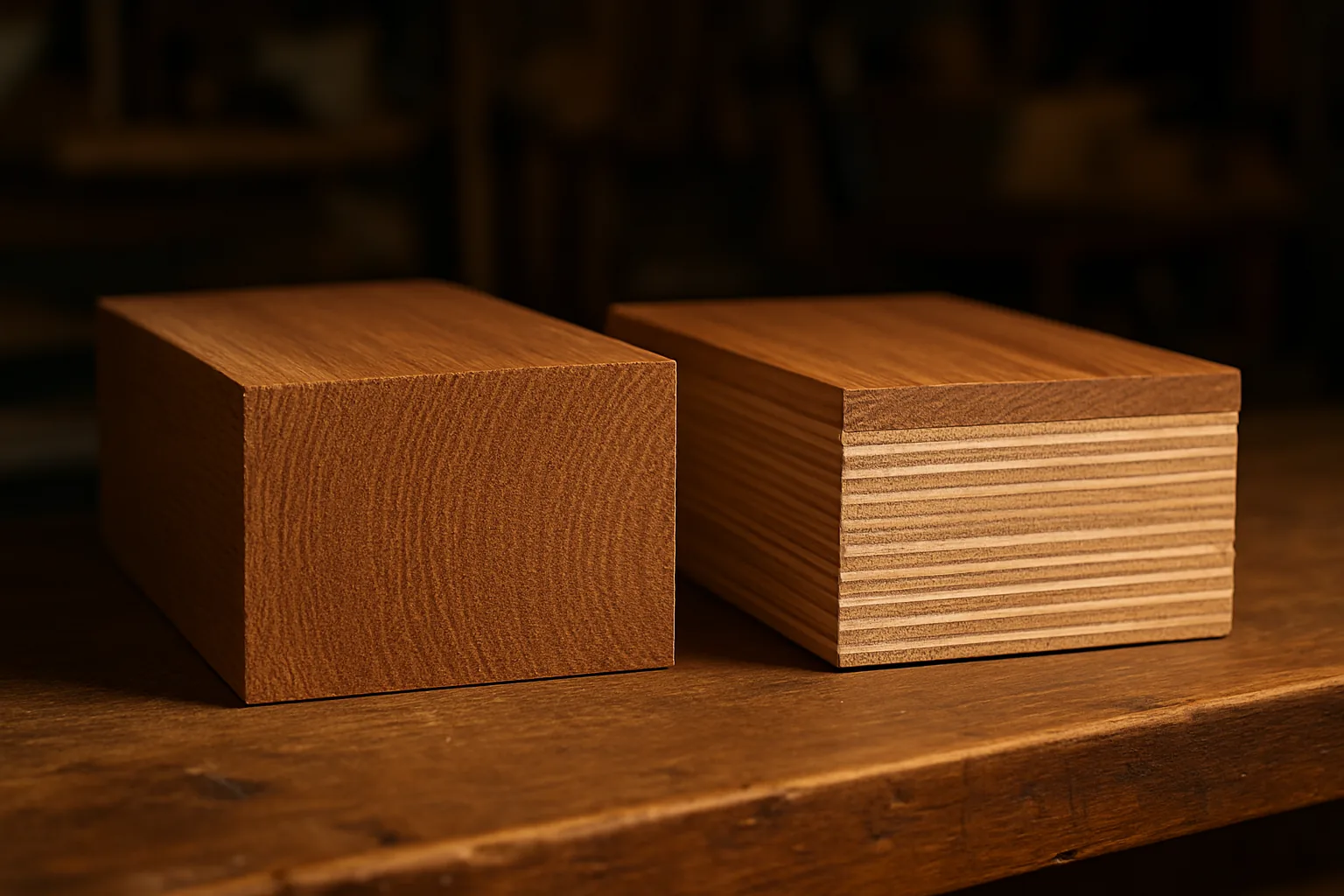
- Veneer over engineered core: A thin slice of real wood (sometimes as thin as 0.6mm) applied over MDF or particleboard to give the appearance of solid wood.
Most flat-pack and big-box furniture uses particleboard or MDF cores with a veneer or printed laminate surface. When people say “engineered wood furniture,” this is usually what they mean.
What Is Solid Hardwood?
Solid hardwood furniture is cut from a single species of deciduous tree — maple, oak, walnut, cherry, ash, and others. Every board used in construction is real, through-and-through wood. There are no composite layers, no adhesive cores, and no printed surfaces pretending to be grain.
Hardness is measured using the Janka hardness scale. Hard maple, for example, rates at around 1,450 lbf. White oak sits around 1,360 lbf. These are woods that can take decades of daily use and still be refinished to look new again.
The Durability Gap: Why Solid Wood Lasts Longer
Structural Integrity Under Stress
This is the most important difference in a solid hardwood vs engineered wood furniture comparison: how each material handles stress over time.
Particleboard and MDF have no real grain structure. The fibres inside them run in no particular direction, which means they distribute force unevenly. A dining chair leg mortised into an MDF rail, for example, will gradually enlarge that joint through normal movement and weight. Once the connection loosens, the glue can’t re-bond the crumbling fibres around it. The piece is effectively done.
Solid hardwood has long, interlocking grain fibres that give it tensile strength in multiple directions. A properly jointed hardwood chair — one using traditional mortise-and-tenon or drawbored construction — can be disassembled, reglued, and put back into service. Many Victorian-era hardwood chairs are still in use today. You won’t find a 130-year-old flat-pack bookcase.
Moisture Response and Real-World Conditions
Engineered wood products, particularly MDF and particleboard, are extremely sensitive to humidity and moisture exposure. Swelling, delamination, and surface bubbling are common results of even moderate moisture — a spilled drink, a humid basement, or seasonal changes in a poorly insulated room.
Solid hardwood does move with humidity (this is called wood movement, and it’s normal). A well-built hardwood piece accounts for this movement through smart joinery and construction. The wood swells and contracts, but the piece holds together because it was designed to accommodate that behaviour.
Refinishability: The Gift That Keeps Giving
One of the clearest arguments for solid wood durability is what happens when the surface gets damaged.
When a solid hardwood tabletop gets scratched, gouged, or stained, it can be sanded back and refinished. You’re working with real wood all the way through — there’s material to remove and renew. A well-maintained hardwood floor or tabletop can be refinished multiple times over its life.
A veneer surface? You typically get one shot before you hit the core beneath. Sand too aggressively and you’re through the veneer entirely. Laminate and printed surfaces can’t be refinished at all.
The Economics of Hardwood Longevity
Cost Per Year of Use
Sticker price is the obvious place shoppers start, and engineered products almost always win that comparison upfront. A particleboard dining table might cost $400. A comparable solid maple table from a custom shop might cost $1,800 or more.
But here’s a more useful calculation: cost per year of use.
If that $400 table lasts 5–7 years before it needs replacing, your annual cost is roughly $60–$80/year. If the solid maple table lasts 30–50 years (or longer, with basic care), your annual cost drops to $36–$60/year — and that doesn’t account for the fact that a well-made hardwood piece often holds or increases its value, while engineered furniture has essentially zero resale value.
Environmental Cost of Replacement
There’s an environmental argument here too. Every time an engineered wood piece ends up in a landfill — and most do — you’re adding manufactured composite materials that don’t break down cleanly. Solid hardwood from responsibly sourced forests is a renewable material, and a piece that lasts 50 years represents far less environmental impact over its life than a piece replaced every five.
Where Engineered Wood Has a Role
A fair engineered wood comparison has to acknowledge where these materials genuinely make sense.
Plywood — real structural plywood with hardwood face veneers — is actually a legitimate building material used in quality cabinetry and furniture. It’s dimensionally stable and resists warping better than solid wood in some applications. Many skilled furniture makers use Baltic birch plywood for drawer boxes and cabinet backs without apology.
Similarly, in built-in applications — shelving inside a closet, the back panel of a cabinet, secondary structural elements — engineered products can be entirely appropriate.
The issue is when particleboard and MDF are used as primary structural components in furniture marketed as comparable to solid wood, often at only marginally lower prices.
What to Look For When You’re Shopping
Questions to Ask Before You Buy
When you’re evaluating a piece of furniture and the marketing language is vague, here are some questions worth asking:
- “What is the primary structural material?” — The answer should be specific. “Wood” is not specific enough.
- “What is the tabletop/surface made of?” — Is it solid wood, veneer over MDF, or laminate?
- “What joinery is used?” — Mortise-and-tenon, dovetail, and dowel joinery indicate quality. Cam locks and staples don’t.
- “Can this piece be repaired if it’s damaged?” — Any honest maker will tell you what’s actually possible.
Signs of Solid Hardwood Construction
Look at the edges of shelves and surfaces — solid wood will show end grain at the corners. Check underneath tabletops for consistent grain running through. Ask to see the underside of drawers. In quality solid wood pieces, even the secondary surfaces are real wood.
The Black Barrel Perspective
At Black Barrel Wood Co., we work almost exclusively with solid North American hardwoods — maple, walnut, white oak, and cherry among them. Every piece we build is designed to be used hard, passed down, and repaired if needed. That’s not a sales pitch; it’s just the only way we know how to build furniture.
We get a lot of questions from customers who’ve been burned by furniture that didn’t last — and we always try to give honest answers, even when the honest answer is “you might not need a custom piece for that application.”
If you’re trying to figure out whether solid hardwood is the right choice for a specific project, we’re happy to talk it through. Reach out to us through our contact page — no pressure, just a straight conversation about what makes sense for your space and budget.
The Bottom Line on Solid Hardwood vs Engineered Wood Furniture
The solid hardwood vs engineered wood furniture question really comes down to this: what do you want from a piece of furniture, and over what time horizon?
If you need something inexpensive and temporary — a first apartment, a short-term rental, a space you know you’ll redesign in a few years — engineered products may be a perfectly rational choice.
But if you’re furnishing a home you plan to live in, a dining table your family will use every day, a bed frame that has to hold up for decades, or a piece you’d like to eventually pass on — solid hardwood is the only material that can actually deliver on that expectation.
Hardwood longevity isn’t a marketing claim. It’s the result of millions of years of the material evolving to be structurally tough, and thousands of years of woodworkers learning how to use it properly.
Good furniture should outlast trends, outlast the house it’s in, and outlast the person who bought it. That’s what we build toward.
If you’re ready to start a custom project or just want to explore what’s possible, get in touch with our team. We’d love to hear what you have in mind.
Ready to start your own project?
Every piece is built to order in our Innisfil, Ontario studio. Reach out to discuss your vision.
Start a Project